Showing posts with label history. Show all posts

Friday, November 27, 2009

Museum Day

For the past month (at least) our neighbors have been renovating. The noise of electric saws and excessive hammering has woken me up almost all of those days and is often mixed with yelling. This morning was no different but somehow irritated me more than normal. I showered and left the house for a full day of museums.

My first stop was the Immigration Museum, which is located in the beautiful old Customs House. I had already known most of the general information from history classes so I was able to focus more on the specific details of various immigrants' journeys.

Quick timeline of significant events:
1788 Britain sends convicts to Sydney.
1848 First non-British ship of settlers comes from Germany.
1860 British agents paid to recruit unmarried women to Victoria.
1861 Legislation confines Aboriginals to reserves & missions.
1888 Chinese prevented from disembarking ships in Sydney and Melbourne.
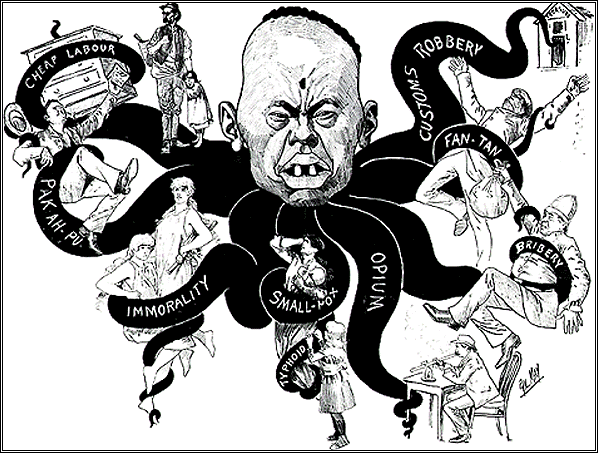
1892 Colonial government restricts all non-European immigration.
1901 Federation of Australia.
1965 Labor Party removes the "White Australia Policy" from their platform.
1967 Aboriginals counted in census and governed by Federal legislation.
1993 Native Title Act recognizes Aboriginal rights to their land.

The museum also had a spectacular exhibit about Hampi in southern India. In addition to hundreds of photos taken of ancient Hindu temples and beautiful ruins, there were a couple interactive rooms utilizing techniques I'd never seen before.

One room had a light table with photographs spread across the surface. Each photo had a barcode; when scanned, the slide projector would enlarge the photograph and show it on the wall with a description about the particular image.
Below image from UNSW iCinema Centre

Another room housed a circular screen with panoramic, 3D images of various sites. Visitors stand on a platform in the center of the room and move the projector to both choose which site they would like to visit as well as move around within that site. Other visitors can stand around the room and explore the 3D element of the video, sensing the depth of ancient temples and examining ruins.

Next up was the Australian Centre for the Moving Image. The current exhibit is about the history of technological advances in video. There was information about video games, early TV, cinema, YouTube and so on. Though the material may not sound incredibly new to many of my generation, the reason for visiting ACMI is often to experience the displays.

Highlights included a massive zoetrope, an interactive monster-making silhouette screen and a multi-camera sphere akin to The Matrix.

My favorite was Anthony McCall's You and I, Horizontal. Upon stepping into the dark room filled with fog machine haze and beams of light, you may not think it will be more than a few seconds of entertainment. After all, the light projection on the wall is just a simple outline of a geometric shape. So you take a few steps into the room and block part of the light. Your shadow breaks up the shape on the wall, but it also breaks up the beam of light traveling across the room. And as you continue to move through the beams you start to play more with the light. You can duck underneath the beams, try to block large portions, small portions, or just watch the swirls of fog traverse across the room. And if you wave your hand rapidly enough through the light, colors appear between your fingers.

The third and final museum of the day was the Ian Potter Centre: National Gallery of Victoria Australia. The collection of work by Australian artists ranges across time periods, genre and artist backgrounds. It covers immigrant settlers' work as well as Aboriginal sculptures and paintings.

The architecture is quite impressive as well. Some art museums attempt to be works of art on their own, and it doesn't always work, but this one does. Placed inside Federation Square, the sharp-angled windows mimic the rest of the building and frame highlights of the cityscape, turning the city into a piece of art itself.

Sunday, November 22, 2009

Pipemakers Park, Circus

On Friday, the Melbourne Women's Circus opened their end-of-year show. The venue was an old bluestone building in Pipemakers Park. In the late 1800s, the area belonged to a large meat cannery. The business began as a way to make use of sheep no longer suitable for shearing and it did good business for quite a few years.

Walter Hume purchased the land in 1912 and started up a concrete pipe factory with his brother. Within a couple decades the Hume Pipe Factory had become the largest supplier in Australia and exported their goods worldwide. Additional buildings were constructed for increased labor and production; but the company's continued growth led its relocation to Laverton where more space was available. The factory still produces pipes today.

While the factory was located along the Maribyrnong River, many pipemakers enjoyed spending free time on gardening. The location was ideal for growing plants and some men used leftover factory materials to craft structures for the garden.

I read inside a large pipe, out of the rain, while waiting for the show to begin.

The Women's Circus is not a professional circus; rather, it's a community of women from across the city with different strengths and different reasons for coming to circus. Some women are in their 20s, some in their 50s. And they all are amazing to watch.
photo from Womens Circus
It started up in 1991 as a resource for women of sexual abuse. It was meant to be a safe environment where they could learn to take control of their bodies and appreciate them in a new way. Other women use the circus to focus on the strength of their bodies instead of just appearance.

Two of my housemates performed in the show. All three of them actually take circus classes, but Hannah chose not to be a part of the show. Scarlet did trapeze and acrobatics, Jayt played with fire and rolled in a barrel. Though the latter doesn't sound incredibly interesting, it works very well as a humorous interlude. Overall, the show was a fantastic blend of physical beauty, amazing feats and comedy.

Friday, November 20, 2009

Sydney, Day 2

We started off our second day in Sydney by visiting the aquarium. In addition to a variety of fish, there were fantastic glass tunnels underneath the water of two large tanks. One held the dugongs, the other had sharks.

Dugongs are very similar to manatees, with one main difference being their tail shapes. Manatees' tails are round and paddle-shaped while dugongs have fluked tails similar to whales.

After the aquarium we walked along the Harbor Bridge for a view of the city. The bridge was first proposed in 1815 by a convict-architect. No action was taken and more people continued to make proposals until the bridge was finally under construction in 1924. The bridge was completed in 1932. During construction, over 100 buildings had been demolished. While this initially seemed unfortunate, the rebuilding of destroyed buildings provided work for many residents in the Depression.

As we made our way to the Royal Botanic Gardens, I stopped to listen to a man playing didgeridoo on the footpath by Circular Quay. He had a techno-esque beat on CD and was playing didgeridoo over it.

We walked into the Royal Botanic Gardens and were both excited to see the sign that read:
Please walk on the grass. We also invite you to smell the roses, hug the trees, talk to the birds, sit on the benches and picnic on the lawns.
My feet were sore so I took full advantage of the cool, plush lawns. It felt like walking on a pillow while icing your feet.

Annoyingly, the pyramid glass house had closed for the evening; though, there was also an entrance fee that I don't think I would have been willing to pay had it been open. There was more than enough to see in the rest of the gardens.

Thursday, November 19, 2009

Sydney, Day 1

According to some people, you can't go to Australia without visiting Sydney. This idea had been pounded into Kelly's mind as well as a bit in my own. It's the largest city in the country and home of the picturesque opera house, which, arguably, is Australia's best known landmark.

By the time we were able to make concrete plans about when to take this vacation all the flights had significantly gone up in price. We considered renting a car but everyone who heard this idea said not to drive. Apparently, the scenery is incredibly boring along the Hume highway. Kelly wanted to see it anyway, and with a rideshare I found on Gumtree (a site akin to Craigslist) it was about 1/4 the price of flying, so we drove up north.

Everyone was right about the view. There was a whole lot of nothing. It was beautiful as the sun set on rolling hills... but that was only for a few minutes of the 10-hour drive.

We arrived in Sydney around 5am and slept in the car for a couple hours before heading out. After stopping for coffee and breakfast, we took the scenic route to our hostel to drop off bags. I was incredibly excited to walk through Hyde Park (and the day after the suburb of Haymarket) as a reminder of my Chicago home.


The Archibald Fountain in Hyde Park was gifted to the city with funds bequeathed in J F Archibald's will. The fountain is meant to commemorate the efforts of France and Australia in World War One--a peculiar statement as it was given to Australia by an Australian, not the French. Archibald was enamored with the French and even changed his name from John Feltham to Jules François. He was also co-owner and creator of the misogynistic, racist, anti-clerical Bulletin news magazine. Quite a character behind such a beautiful fountain.

As we walked along small streets to get a feel for the city, one block quickly switched from rows of buildings to a large cliff with apartments on top. No other cliffs were around; it was quite strange.

Beautiful purple Jacaranda trees lined many of the streets; their fallen flowers decorated footpaths like confetti.

It had been a while since I'd traveled with another person and my style of vacationing didn't always mesh well with Kelly's. She's more inclined to browse through various shops; I'm far more interested in stopping read plaques. Over the course of our trip I tried to stop less frequently and decided to photograph the plaques to read later so I wouldn't cramp her style.


The hostel we stayed at had spectacularly painted doors for each of the rooms. Some were superheroes (Wolverine), some were movie characters (Harry Potter, Holly Golightly from Breakfast at Tiffany's) and others were abstract designs. They also gave each guest a map and book of coupons upon check-in, which we made good use of.


After dropping off our bags, Kelly and I went out to see The Rocks, Sydney's oldest district. England granted land and convict labor to men willing to settle in the new country. In 1788, the first group of men and convicts arrived in Sydney. There wasn't a prison until 1819, when the Hyde Park Barracks were built, and even then it was only some convicts who slept in the prison. Rather, the convicts stayed in cabins they built in a separate area from the settlers.

Governor Macquarie wanted Sydney to become less of a penal colony and transform into a city. The trade and shipping industries aided the town in growth. By 1840 convict transportation to Sydney had ceased and about 35,000 people resided in the city. Sailors became frequent visitors and pubs popped up everywhere, often with a seafaring name. As the population grew, more schools and stores were also built. "Ragged schools" were made for destitute children and named as such to discourage parents who could afford to pay for education.

Now the district is home to a variety of restaurants, small shops, museums and art galleries.

Kelly and I headed off to Featherdale Wildlife Park in one of the western suburbs. Wallabies and kangaroos roamed freely through the park, as did various birds that Kelly was scared of. Actually, she was scared of the marsupials as well. After passing through one of the gates, I was surprised to find my feet were almost touching a kangaroo's nose. It had bent down behind the gate so I didn't see it before almost walking into its face.

There were also fairy penguins, wombats, Tasmanian devils, echidna, koalas, dingoes, emus, quolls, quokkas...


We spent our evening admiring lightning while aboard a ferry going north across the harbor, then continued to gaze upon the sky show from the beach at Manly.

Sunday, November 15, 2009

Launceston, Take Two

My last day in Tasmania was spent back in Launceston.

I went to the local museum, looked at some art and explored the old blacksmith workshop, which was still in use until the 1990s. There was also a theater showing old government videos. One of the videos was to record the beauty of a small lake in the middle of the mountains before it was to be flooded and destroyed for the creation of another dam. The government recognized the area was unique and paid for this film to be made, but for some reason it didn't seem worth saving the actual lake.

There really wasn't anything left that seemed necessary to see so I spent the day wandering around town and drawing at a cafe.

Hobart

I was relieved to be in Hobart and see people walking about. With 210,000 it's about twice the population of Launceston, and 300 times that of Strahan.

I started off at the museum/art gallery. There was a large variety of things all packed into the building. It's not that it was small or had little to tell about each subject, it was just a very good use of space. Areas of the museum included exhibits about local Aboriginal cultures, civil rights, ships, Antarctic exploration, prison colonies such as Port Arthur, woodcraft, modern art, Chinese art and calligraphy. It was a bit overwhelming.

Though plenty of things in the museum were intriguing, my favorite was probably learning that Aboriginal Tasmanians have a style of basket unique to their culture. They craft water carriers out of large pieces of kelp.

Next up was a walk through the domains and along Soldiers Walk where men are remembered by plaques and trees planted in their names. In 1917 the walk was established. Queen's Domain has since gone through renovations and replanting upon realizing that it would be better to have native trees in the domain.

In the evening I went to a comedy show at the Brisbane Hotel. Some of the comedians were a bit less than funny, but others were hilarious. And the host of the show was spectacular with short bits and banter. There were contests involving Nerf guns and stuffed ducks, a video satire of Frasier, and a few talks with a vampire off stage.

Headlining the evening was Tom Ballard, who won best newcomer at the Melbourne International Comedy Festival this year and works for youth radio station Triple J. We made plans during his show to go out afterward (it's slightly awkward to converse with someone while they are on stage) but the place we intended to go was closed. Instead, I just talk to him and a few other people after the show.

In the morning I headed off to the botanic gardens. Most people have places they tend to visit when traveling; I always like to visit parks and gardens. There was an enclosed area with sub-Antarctic plants. Since the 1950s, Australia's Antarctic territory, Macquarie Island, has been a place for scientists to study the climate down under the down under. The cold house in the botanic gardens mimics the Antarctic climate and exhibits native plants.

After the gardens I went to visit the Penitentiary Chapel. In the early 1800s more and more convicts were being shipped to Tasmania and the current prison wasn't large enough to accommodate them all. Plans were created to build a new, larger prison. So the convicts labored to build the sandstone bricks and make their future cells. After the new penitentiary had been established, it was decided to add on a chapel to aid in the convicts' reform. It was believed that they would never overcome their evil habits without Christianity. The chapel was built with sloping pews to accommodate for cells underneath the floorboards. Luckier convicts got the tall cells in the back, others were forced to crouch into the tiny cells near the front.

Eventually, fewer convicts were being sent to Hobart because the government decided perhaps not every rumored thief should automatically be imprisoned. Because the prison needed less space, two sections of it were closed and turned into courts.

The day was an eclectic mix of activities. After the penitentiary, I went to Town Hall for a flower show with gorgeous irises and mixed arrangements. I was amid a group mostly composed of old women and families.

And after the flower show I stopped off at the Lark Distillery for a tasting of their whiskeys and spirits. The staff was incredibly friendly and the small number of customers allowed for a quite personalized experience.

Wednesday, October 28, 2009

Pauline, Pauline

With the final day of classes tomorrow, we conclude the course on Australian history with the recent controversies surrounding one miss Pauline Hanson.

For anyone unfamiliar with her career in politics, here's a very brief rundown:
Hanson created the One Nation Party, which was established as a corporation and run by the company/party directors instead of through democratic process. She was elected to office and gave a speech including racist statements on the threat that Australia would be "swamped by Asians." There was a significant amount of public support and protest after her election, and Hanson was one of the main figures in the Australian media between 1996 and 1998. Later, she was convicted of election fraud. And recently she's remained in the spotlight on "Dancing with the Stars" and back in the political sphere in '07 when she trying to launch yet another new party.